Scaling plug-and-play robotics to hundreds of sites will drive Amazon’s profitability when it matters most.
By scaling plug-and-play robotics across hundreds of locations, Amazon secures a profitability boost exactly when it’s needed most.

Invest in the Future
“Never, ever invest in the present. It doesn’t matter what a company’s earning, what they have earned. […] You have to visualize the situation 18 months from now, and whatever that is, that’s where the price will be, not where it is today. And too many people tend to look at the present, […] but you have to look to the future.
— Stanley Druckenmiller
Stanley Druckenmiller is one of the all-time greats. I’m sure he doesn’t need an introduction. I watch what he does and what he says very closely. And by very closely I mean I probably listened to every interview he ever gave at least two times.
And there is one thing he always comes back to. That is the quote from above. He said it many times that as an investor you should not focus on the present but you have to look ahead and paint a picture of what the future will look like in the next 18 months.
And when he has a view on the future, he doesn’t stop there but he does what he calls “playing around the concentric circles that develop”. To me this is a beautiful metaphor:
Imagine catapulting a large stone into a lake that is full of floating objects on the surface. You have to anticipate where the stone drops. And when it does, it will create a splash and concentric circles. As time moves on, the circles get wider and touch different objects, with varying intensity. It impacts the way that these objects float. The ones that are close to the impact of the stone move more than those that are further away from the impact.
Druckenmiller uses this metaphor to guide his moves in the stock market. The floating objects are the different businesses that are impacted by certain events. A recent example was the release of ChatGPT and the rise of LLMs.
Druckenmiller did not only buy NVIDIA but he thought ahead of time and tried to figure out which businesses will be impacted by the release of LLMs. As a result he also moved into energy, turbines, different semiconductors and copper. And it has worked rather well.
You are probably wondering what this has to do with Amazon Robotics, don’t you? We’ll get to that. But before moving to Amazon Robotics, I want to tell you what Druckenmiller has done in Q4 of 2025. How has he positioned his fund? What were his big moves? In a few days we will also know what he has done in Q1 of 2026. But now to Q4 of 2025:
Amazon: added 69%. Now a 4% position.
Coupang: added 46%. Another ~4% position.
Sea Ltd.: added 244%. Now a ~3% position.
I’ll tell you what I think I observed:
Druckenmiller is doubling down on Amazon, Coupang and Sea Ltd.
These businesses are massive closed-loop logistics laboratories. They control the entire chain from the website to the last-mile delivery.
They will use inference and edge compute to orchestrate hundreds of thousands of robots in real-time. Amazon deploys more than 1 million robots. He bets that those logistics players have the best short term profitability gains ahead of them. At least that’s my take on it.
I think because they will be able to improve their relatively low margins on their biggest revenue base: Selling stuff online, packaging it up, and delivering it to your home.
Next, I will explain, why I think that this is the reason for his trades.
We will take a close look at Amazon. Because I think they are best positioned. Before Amazon ran up to $270 per share I doubled my position at ~$220.
Unlocking Profitability through Tech
The basis of this article are Physical AI, inference compute, and edge compute. And if you are like Stan Druckenmiller in his latest Morgan Stanley interview and think “This goes all right over Stan’s head.”, go ahead and read the article that I wrote about automation and inference AI applications in the physical world. I tried to write it in a way that everyone can understand the topic of automation and how Smart Objects (those are physical objects equipped with sensors) communicate with one another in our physical world. It is basically the primer for the article you are reading now.

I don’t want to repeat everything I said in the article linked above but I feel like a small summary is appropriate to explain what Physical AI, inference and edge computing are:
In the world of AI there is the training of the models and inference. Inference happens when you access a pre-trained model to solve a “problem” or task. It is what happens when you use Gemini, Claude, or ChatGPT.
Now Physical AI is basically what happens when a Smart Object sends data to a pre-trained model and the AI comes up with a solution which the Smart Object then executes in the physical world.
In some instances sending that live data to a distant server for processing takes far too long, which is why this crucial inference phase is powered by edge computing, which means locally, right on the device. This eliminates dangerous lag and allows the machines to react to their environment instantly and safely.
To get back to the Druckenmiller quote from above: The title of my last article indicates, I believe AI training was the appetizer and inference and physical AI will be the main course. What do I mean by that?
So far the main beneficiaries of AI have been the picks and shovels companies. Those that sell the hardware which is needed for the training of the models, and energy-related businesses that deliver the electricity that is needed to power the compute.
I believe that we are in a transition phase and that over the next 18 months we will see the first major improvements in profit margins in the businesses that apply Physical AI on the shop floor level.
I believe that the application of physical AI benefits almost all manufacturing companies. But automation and the application of Physical AI is not easy. In fact it is very difficult. And automating tasks always takes longer than initially anticipated.
Therefore I believe the main beneficiaries are not the businesses that find the one best use case for automation and application of Physical AI.
It will be the businesses that have a few dozen use cases which they can explore, solve, and then massively scale through hundreds of different locations.
To me the absolute prime candidate for the application of Physical AI are fulfillment centers and warehouses. Where else do you have more menial, mundane, and repetitive tasks? Those tasks are the best tasks to automate!
Tye Brady, the Chief Technologist at Amazon Robotics, is the figure most associated with this philosophy. He always says, “Our goal is to eliminate every menial, mundane, and repetitive task.” And just to be clear, by “eliminate” he means eliminate it from the list of tasks that humans do. The goal is to give workers more meaningful things to do, not to fire them.
I don’t want to start a huge discussion about this topic. But I just want to highlight that I agree with Tye Brady, because one of the main reasons for automating tasks is to protect the human workforce. Humans are not made for repetitive tasks for 8 to 12 hours a day, 5 days a week. Repetitive task injuries are very common and even occur where you first wouldn’t expect them. People delivering packages with a delivery van, for example. Every time they get out of the van or get back into the van, they tilt their hip sideways. Doesn’t matter if they enter or exit the van. They always lengthen the left side and shorten the right side of their body. Do this 100 times a day for 20 years and you will get a problem.
Amazon
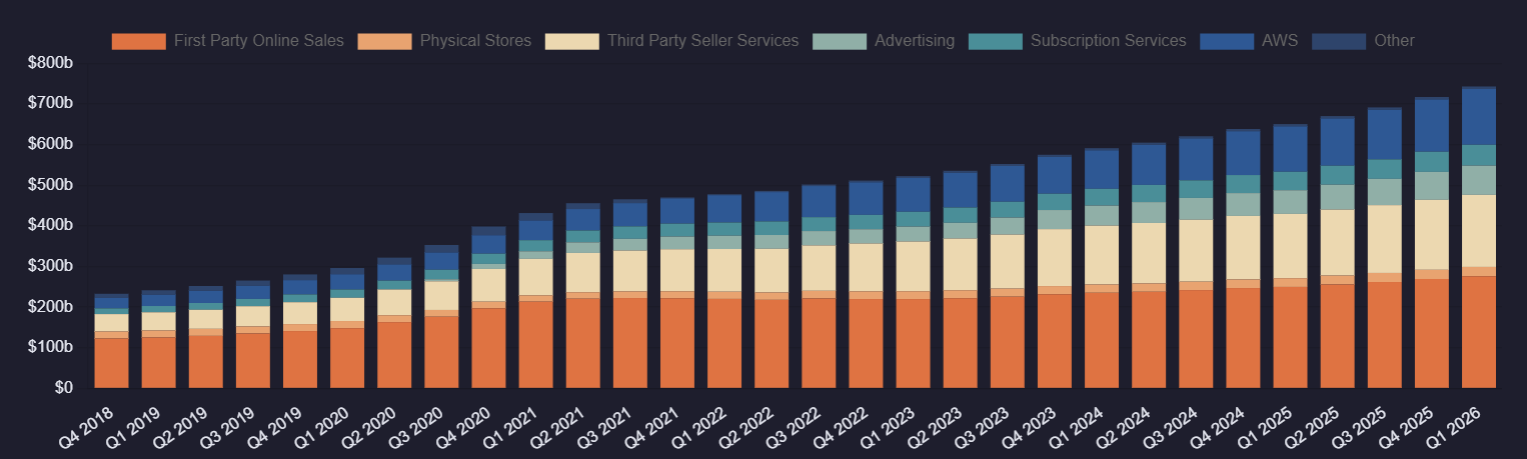
Amazon’s core retail engine is its First-Party Online Sales and Third-Party Seller Services. They represent a massive revenue base of more than 50% that has historically operated on thin margins.
While the divisions AWS and Advertising often dominate the headlines, the true frontier for unlocking operating leverage lies within the massive "Fulfillment" cost line. This expense category captures the immense capital and labor required to move millions of packages through a global network of warehouses and fulfillment centers.
By integrating Physical AI and advanced robotics, Amazon is systematically attacking these physical friction points. These technologies allow for unprecedented efficiency in sorting and package handling, directly reducing the cost per unit.
The main target lies in the sheer scale of the retail segments, because the revenue denominator is so vast, even a modest 1% expansion in operating margin translates into billions of dollars in profits. This money flows directly to the bottom line. It reprices the retail business from a low-margin cost-center to a high-efficiency technological powerhouse.
Physical AI acts as a strategic bridge, turning the heavy physical constraints of traditional commerce into a source of compounding competitive advantage.
I believe the successful deployment of these robotics systems across the fulfillment network could trigger the most significant step-change in profitability in recent years.
I am especially bullish on Amazon’s Automation and Robotics division because fulfillment centers do not only offer great use cases but Amazon has hundreds of fulfillment centers all over the world. And each robotics use case that they explore is afterwards scalable as a plug-and-play solution that can be put into action quickly in all the other locations. And all that doesn’t even mention the idea of re-accelerating AWS growth or the chip business, which is growing triple digits.
Amazon also runs their own inference on AWS of course. While others might have to pay someone for the inference compute, Amazon might have a competitive advantage, because they do it in-house — so there’s no middleman that needs to be paid.
I believe that in a world where inference becomes a commodity utility, the person who owns the utility company (AWS/Silicon) and the warehouse / fulfillment centers wins.
If you’re interested in the technologies that Amazon developed for their own warehouses and fulfillment centers, check out this video. There’s many more available for free on YouTube. But this one includes a lot of them in just one ~10min video, and it also touches on the replacing workers aspect.
Thanks for reading! Thanks for taking the time! Thanks for the support!
And now, back to compounding!!!
Gianni <3
I am not an investment advisor.
This is not financial advice.
This is for informational purposes only.
Curious on how you get so many likes and restacks!
Great post!!! 👏🏼